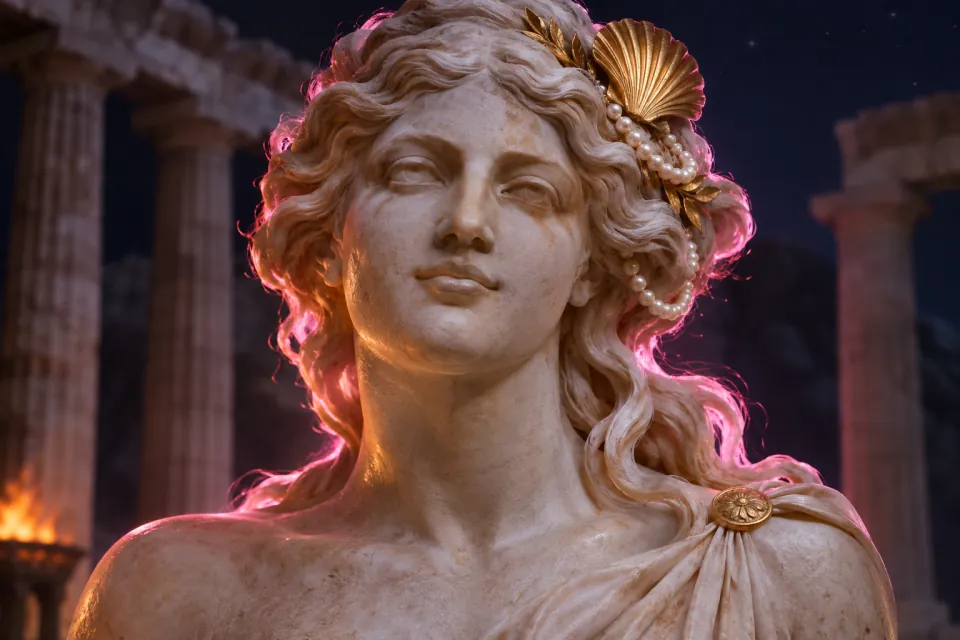
Ἀφροδίτη
Aphrodite阿佛洛狄忒
Roman name Venus
Goddess of love and beauty
LoveBeautyDesire
Meet Aphrodite in the 3D temple ›Origins
There are two accounts. In Hesiod, Cronus castrated the sky-god Uranus and threw the flesh into the sea; she rose from the foam and drifted to Cyprus — which makes her a generation older than Zeus. In Homer she is simply the daughter of Zeus and Dione.
Sacred symbols
Scallop shellDoveRoseThe magic girdle
Myths
The golden apple
Strife threw down a golden apple inscribed "for the fairest," and Hera, Athena and Aphrodite all claimed it. The judge, Paris, chose her because she promised him the most beautiful woman alive — Helen. The Trojan War followed.
Adonis
She loved the beautiful youth Adonis, but a boar gored him to death while he was hunting. Where her tears fell on his blood, anemones bloomed.
Pygmalion
The sculptor Pygmalion fell in love with an ivory girl he had carved himself. Moved by his devotion, Aphrodite gave the statue warmth and breath.
Did you know
Aeneas, her son by the mortal Anchises, escaped from Troy and was honoured as the ancestor of the Romans — Julius Caesar's family claimed descent from her.
Relationships with the other gods
RivalryZeus
A taste of her own medicine
Aphrodite kept making the gods fall for mortals and then laughing at them — Zeus included. So he did the same to her, filling her with desire for the Trojan herdsman Anchises, to whom she bore Aeneas.
RivalryHera
The apple and the magic girdle
Paris gave the golden apple to Aphrodite, and Hera held the grudge for the whole Trojan War. Yet she could swallow her pride when she needed something: to draw Zeus's attention from the battle she borrowed Aphrodite's irresistible girdle, and lulled her husband to sleep.
RivalryAthena
Wisdom against beauty
For the golden apple Athena offered Paris wisdom and victory; Aphrodite offered him a woman — and won. Athena collected on the battlefield: first she urged Diomedes to stab Aphrodite's hand and sneered that she must have scratched it on a brooch, and later simply knocked her flat with her fist.
DesireAres
Lovers in the golden net
Love and War were the most famous lovers on Olympus, meeting whenever Hephaestus was away. Their children were Phobos (Fear), Deimos (Dread) and Harmonia (Harmony) — what comes of love joined to war is terror, and also concord.
DesireHephaestus
The worst-matched marriage
The most beautiful goddess was married to the ugliest god. When the Sun told him about Ares, he forged a golden net too fine to see, caught the pair in bed, and threw the doors open for the gods to look. The gods all came to enjoy it; the goddesses stayed home out of modesty.
DesireHermes
A joke beside the net
Looking at the pair in the net, Apollo teased Hermes: would he be willing to lie there beside her, tied up like that? Hermes said he would, with three times the chains and every god watching. In time he got his wish, and their child was named Hermaphroditus — both parents' names in one.
RivalryArtemis
Beyond Aphrodite's reach
Aphrodite can master every god and mortal except three goddesses: Athena, Artemis and Hestia. Young Hippolytus honoured only the huntress and scorned love, so Aphrodite made his stepmother fall in love with him and brought about his terrible death. Artemis could not save him; she could only swear revenge.